Business Analysis
- Strategy, Systems
Business Analysis is the practice of identifying business needs, problems and opportunities, and then defining the most suitable solutions to address them. For SMEs, Business Analysis is essentially structured problem solving, replacing reactive fire fighting with deliberate processes.
Business Analysis can be conducted at all scales, from brief reviews of known problem areas to comprehensive analysis of all business processes and systems. In all cases the process begins with information gathering (Elicitation), to understand the current state of the business. This part of the process can include in person methods such as interviews, surveys, and observation, as well as analysis of company documentation, structures and processes. Once the current state is understood, findings are viewed with relevant stakeholders to identify problems and opportunities.
Once problems and opportunities are identified, solutions are developed and evaluated in terms of likely effectiveness and suitability for the business. Guided by our core principles of Simplicity & Value, we seek solutions that can be readily be adopted and maintained by the business, and with clear benefits relative to their cost. While working to these principles we are also able to assist with large scale change when there is a clear need for more transformative solutions.
Core Activities
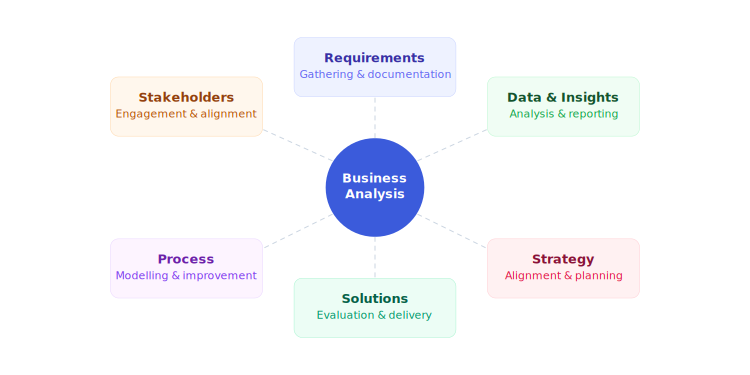
- Requirements Gathering: Documenting the current state and needs of the business
- Process Mapping: Visualising how work flows through an organisation to find inefficiencies
- Gap Analysis: Comparing current state ("as-is") to desired future state ("to-be")
- Data nalysis: Using metrics and KPIs to inform decisions
- Stakeholder Management: Ensuring the right people are involved and aligned
- Solution Evaluation: Recommending solutions and evaluating their suitability
How Business Analysis Helps Small and Medium-Sized Businesses:
Eliminating waste:
SMEs often grow organically, accumulating redundant processes. Business Analysis exposes
bottlenecks and manual steps that can be automated or cut, directly reducing costs.
Smarter technology decisions:
Before buying software, a Business Analysis approach defines what problem you're solving. This prevents expensive
purchases that don't fit the actual need — a common and costly mistake for SMEs.
Scalability planning:
Processes that work at 10 employees break at 50. Business Analysis helps design workflows that can scale, so growth
doesn't create chaos.
Better customer experience:
Mapping customer-facing processes reveals friction points — slow response times, inconsistent service,
unclear communication — that quietly erode retention.
Data-driven decision making:
Many SMEs run on gut instinct. Business Analysis introduces structured measurement & processes, defining which metrics
matter and building reporting tools to track them.