Forecasting
- Data, Strategy
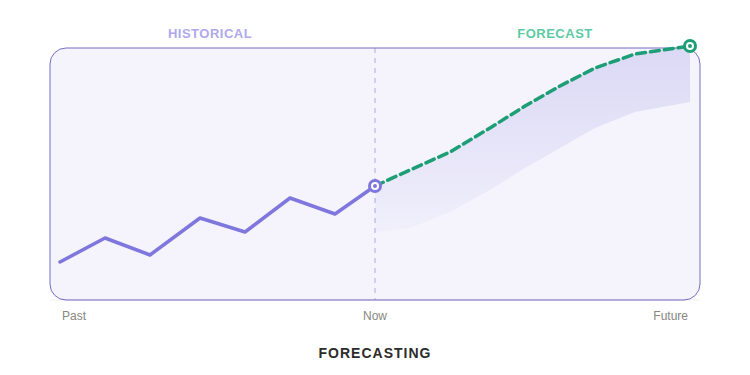
Business Forecasting involves using data and analysis to make informed predictions about future outcomes. This can be internally focussed, such as mapping likely changes in inventory levels, externally focussed such as predicting changes in market conditions, or can involve the combination of internal & external factors to estimate variables such changes in customer demand. Being able to accurately assess likely changes inside and outside your business is an invaluable capability, in responding to changing conditions and planning business change, and has become increasingly important with technological advances providing competitive advantages to the organisations which are able to harness their power.
Business Forecasting can use either qualitative data and methods. Within these two broad categories there are a wide variety of methods and techniques which can be applied, with the choice
of method depending on the data available and the specific requirements of the forecast. Some of the most common methods include:
Delphi Method:
This is a qualitative method which involves gathering expert opinions to make predictions about future events. It is often used when there is a lack of historical data or when the future
is uncertain.
Market Research:
Another qualitative method, this involves polling users and/or prospective customers regarding specific products or services. This provides valuable insights into customer preferences and
behaviors which can be used to make sales projections and informed decisions.
Time-Series:
A quantitative method which uses historical data to identify patterns and make predictions about future outcomes. This is the cornerstone of quantitative forecasting, based on a method which
is easily understandable but which can extend to advanced levels using complex techniques (see below).
Econometric Modelling:
This is a statistical (quantitative) method which uses mathematical models to provide predictions and also define relationships between input variables and their impact on
outcomes. While its name refers to economic data, it can be applied to a wide range of fields, incorporating all kinds of data to refine decision making.
Machine Learning can be used for the above methods, with techniques such as regression analysis & decision trees used to forecast outcomes and techniques such as clustering used to identify hidden groups in data. With the knowledge and when and how to apply these techniques, they can rapidly assess complex data and provide insight not otherwise possible.
Forecasting is a critical capability for businesses, in many cases being the difference between the success and failure of individual initiatives and consequently the business as a whole. With the relevant expertise there is a wide range of methods, techniques and processes which can be implemented in your organisation to provide you with the insight needed to make the right decisions to achieve your goals, and manage risk. From simple processes to advanced techniques Kontekx can help your business move towards a data driven future.